
Crumbling front steps: when to repair them and when to rebuild
On this page · 8 sections
Your front steps get used more than any other part of the outside of your house, and they take a beating most homeowners never think about. Rain soaks into the mortar joints, freezes overnight, and pushes the brick apart a little more every winter. Salt and ice melt eat at the surface. Water from the roof lands right where the steps meet the foundation. Then one spring morning a tread rocks under your foot, and the question becomes: can this be fixed, or does the whole thing have to come out?
It is a fair question, and the honest answer is that plenty of steps only need a repair. But some steps are failing from the inside, and no amount of fresh mortar on top will hold them together. Here is how we sort one from the other when we walk up to a house, and what you can check yourself before you ever pick up the phone.
The short answer
Bottom Line Up Front
If your steps sit level and the damage is a cracked tread, a loose brick, or worn mortar joints, repair them. If they are tilting, settling, sounding hollow, or pulling away from the house, the base has failed, and a rebuild is the fix that lasts.
A repair is the right call more often than people expect. But masonry only holds when what is underneath it holds, and New Jersey freeze-thaw winters find every weak spot. The trick is figuring out whether the problem is on the surface or in the structure before another winter makes it worse.
The rest of this post walks through the four questions behind that answer, with a comparison table, a list of signs on each side, and a decision matrix at the end you can run through standing on your own walkway.
Question 1: Is the damage on the surface or in the structure?
Start with what you can see. A cracked stone tread, a few eroded mortar joints, or a chipped brick on the edge of a step is surface damage. The steps are still doing their job; one piece of them wore out. That is a repair. We reset or replace the tread, repoint the joints, and match the existing brick and mortar as closely as the weathering allows.
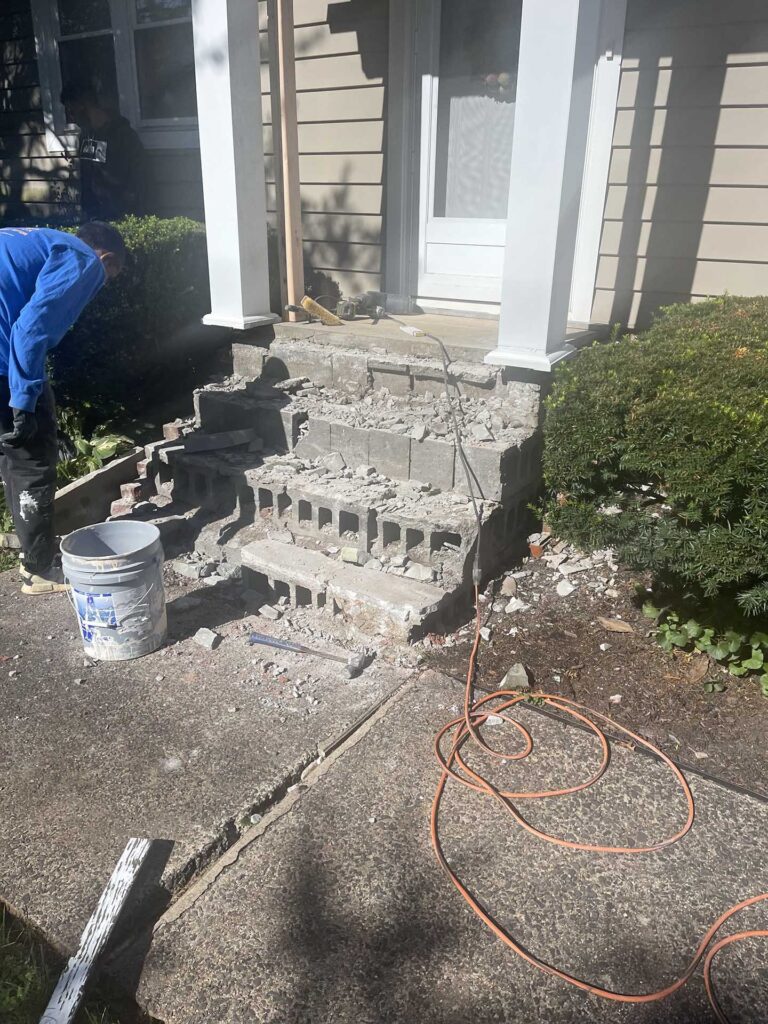
Structural damage looks different. The steps tilt toward the street or away from the door. A gap has opened between the top landing and the house. Several treads move when you step on them, not just one. Those are signs that whatever the steps are sitting on has shifted or washed out, and that is a problem a surface repair cannot reach.
Repair vs. rebuild at a glance
Each row below is one thing that changes the answer. The highlighted cell is the column that wins when that factor is the one driving your decision. Most sets of steps land in more than one row, so look for the column that wins the most of yours.
| Factor | Lean Repair | Lean Rebuild |
|---|---|---|
| What is damaged | One cracked tread or a chipped edge | Several treads and the risers |
| Mortar joints | Eroded in spots, bricks still tight | Bricks loose, rocking, or falling out |
| Level and movement | Steps sit level and feel solid | Tilting, settled, or pulling from the house |
| What's underneath | Solid when you tap the risers | Hollow sound, voids along the sides |
| Material | Brick and stone, mostly sound | Rotted wood or spalling concrete |
| Water | Runoff can be redirected | Water keeps pooling and freezing |
| Railing | Loose anchor in sound masonry | Anchors set in crumbling material |
A lot of step damage starts at the roofline. If a downspout empties right next to your steps, or a gutter overflows above the front door, that water is soaking the masonry and freezing in it all winter. Fixing the steps without fixing the water just starts the clock over. It is worth a look at what neglected gutters do to a house before you budget for new steps.
Question 2: What is happening underneath the steps?
Steps are only as good as the base they sit on. Over years, water running along the foundation can wash soil out from under a set of steps, and older steps were sometimes built over fill that was never properly compacted. When the base goes, the steps settle unevenly, and you see it as cracks that run through several bricks at an angle, treads that are no longer level, or a landing that has dropped away from the threshold.
You cannot see the base from your walkway, but you can see its symptoms. Tap the risers with your knuckle and listen for a hollow sound. Look along the side of the steps for gaps between the masonry and the ground. Check the spot where the top step meets the house. If the steps have moved as a unit, the base is the problem, and a rebuild is how you fix a base.
Question 3: What are the steps made of?
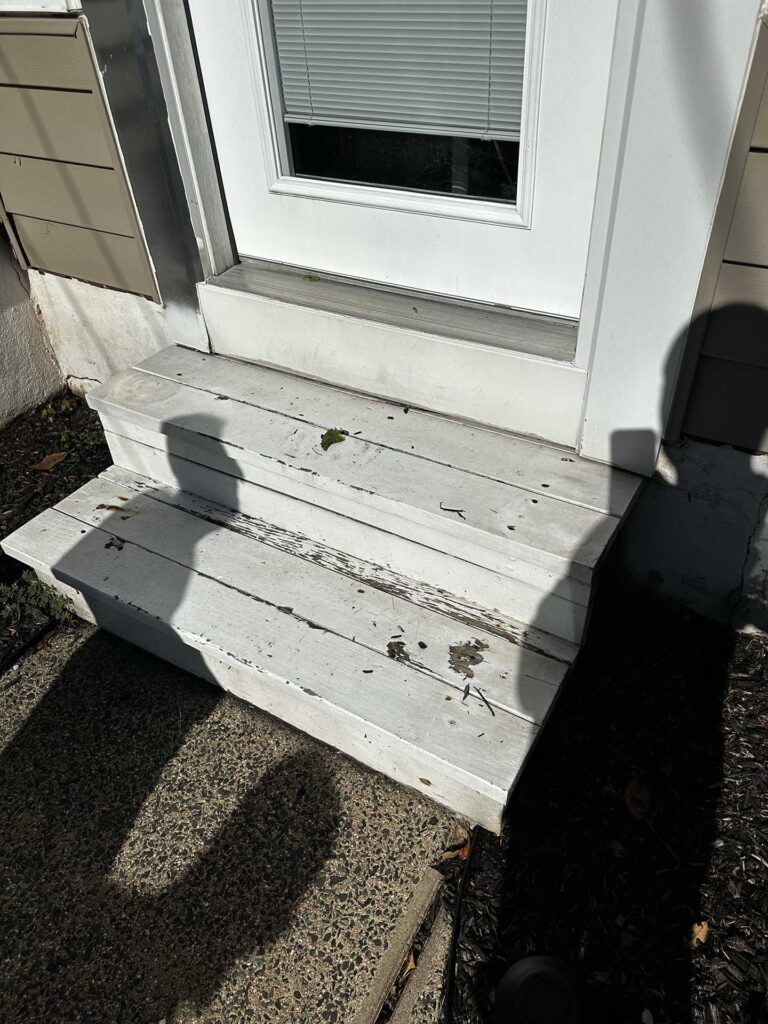
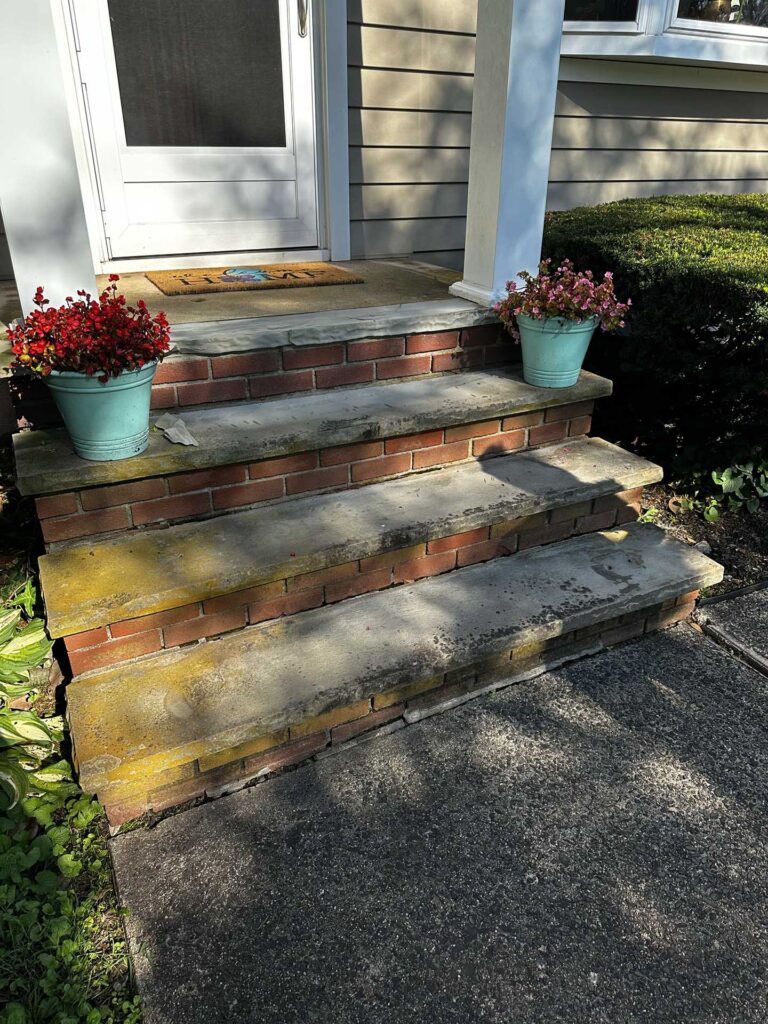
Material matters. Brick steps with stone treads can often be repaired piece by piece for many years, because individual bricks and treads can be reset or replaced without disturbing the rest. Wood steps are a different story: once the paint is peeling and the boards are soft, rot has usually reached the framing, and the fix is replacement. Old poured concrete that is flaking and spalling across the whole surface is rarely worth resurfacing, because the new layer has nothing sound to bond to.
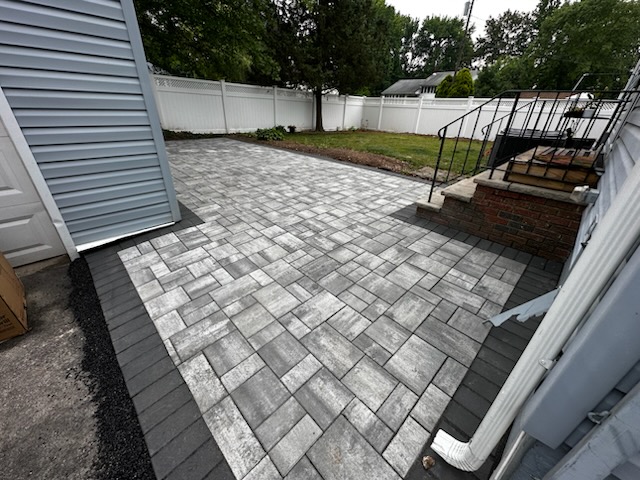
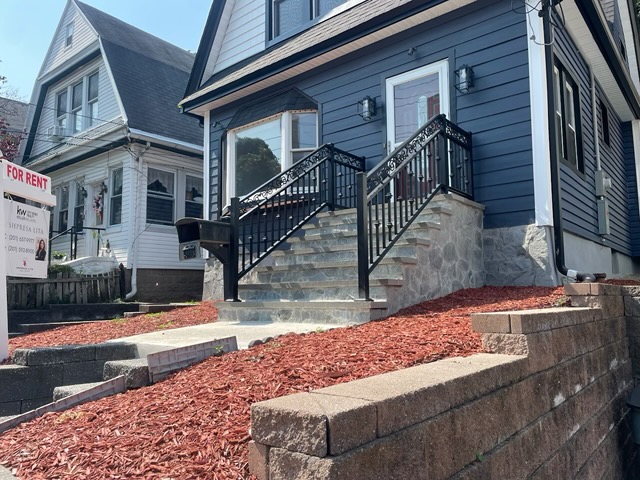
If you are rebuilding anyway, that is the moment to decide what you want the entrance to look like for the next couple of decades. Brick with stone treads, railings anchored into solid masonry, and a paver walkway leading up to the door can change the whole front of a house.
Signs it's a repair
The steps are sound and the problem is contained. Fix the piece that failed and move on.
What we look for
- One tread is cracked or loose, and the steps around it stay put when you stand on them.
- Mortar has worn out of a few joints, but the bricks themselves are tight.
- The landing still meets the threshold with no gap opening up against the house.
- The risers sound solid when you tap them, with no hollow spots.
Signs it's a rebuild
The base has moved or the material has failed. Patching buys a season, not years.
What changes the answer
- The whole set of steps tilts toward the street or away from the door.
- A gap has opened between the top step and the foundation.
- Bricks are loose across several steps, not just one, and new cracks keep appearing.
- Wood steps have soft boards and peeling paint, or concrete is flaking across the entire surface.
Smearing a bag of patching compound over a crumbling step looks tidy for a few weeks. But a patch over loose, wet masonry traps moisture underneath it, and the next freeze pops it right off, often taking more of the original surface with it. A loose railing anchored in crumbling material is worse still: it is the thing someone grabs when they slip. If the steps are moving, treat it as a safety repair, not a cosmetic one, and read why some exterior jobs are better left to a pro.
Question 4: How do the steps fit the rest of the house?
This is the tiebreaker. If the steps could go either way, think about what is around them. Steps that are too narrow for the door, too steep for an older parent to climb comfortably, or a mismatch with siding you just replaced are worth rebuilding on your own schedule rather than patching until they fail. Steps that suit the house and only need some attention are worth keeping.
“The question is never just whether we can patch it. It is whether the patch will still be there after the next winter.”— Dynamic Home Improvements
Here is what a rebuild can look like. Drag the divider to compare a set of worn, peeling wood steps with brick steps and stone treads at the same entrance.
The decision matrix
If you only do one thing with this post, run through this table. Read down the left column, find the rows that describe your steps, and see which column wins most of them.
| If your steps… | Repair | Rebuild |
|---|---|---|
| Have one cracked or loose tread | Yes | Overkill |
| Have worn mortar but tight bricks | Yes, repoint | Premature |
| Are tilting or settling as a unit | Won't hold | Yes |
| Have pulled away from the house | Stopgap only | Yes, usually |
| Sound hollow when you tap them | No | Yes |
| Are wood with soft or rotted boards | Not safe to patch | Yes |
| Have a loose railing | If the masonry is sound | If the anchors are crumbling |
The bottom line
Most worn front steps can be repaired. If the steps sit level, feel solid underfoot, and the damage is a cracked tread or a few tired joints, a repair keeps them safe and good-looking for years. When the steps are moving, sounding hollow, pulling away from the house, or made of material that has given up, rebuilding once is safer and cheaper than patching every spring.
If you are not sure which side of the line your steps are on, that is what a free inspection is for. We will look at the steps, the base, and where the water is coming from, and tell you honestly whether it is a repair or a rebuild. We work throughout the state, with masonry work here in Bergen County and beyond, and you can see finished jobs in our project galleries.